SportsGameOdds: FAQ
September 25, 2025 · Updated October 17, 2025

SportsGameOdds: FAQ
If you’re exploring sports data APIs, you’ve probably come across terms like odds API, sportsbook API, player props API, and wondered what they really mean or which provider is best for your project. To help developers, startups, and sports enthusiasts cut through the noise, we’ve put together answers to the most common questions about odds APIs and SportsGameOdds. Whether you’re building a sports betting platform, a DFS tool, or simply experimenting with sports data, these FAQs will guide you through the essentials — from free tiers and integration tips to historical data and the fastest providers available today.
1. What is an odds API and how does it work?
An odds API is a sports data service that delivers betting odds in a machine-readable format so developers, platforms, and analysts can integrate live and historical odds into their apps or websites. Instead of scraping bookmakers manually, an odds API aggregates odds from multiple sportsbooks and provides them through REST or WebSocket endpoints.
A good odds API gives you access to moneylines, spreads, totals, player props, alternate lines, and even settlement data. Developers can query by sport, league, team, or player and instantly receive JSON responses to power apps, betting models, fantasy tools, or odds comparison sites.
SportsGameOdds, for example, updates every 30–60 seconds and supports 28+ sports, 67+ leagues, and 85+ bookmakers including Bet365, FanDuel, DraftKings, and Pinnacle. That means developers can build reliable sports betting and fantasy products without maintaining dozens of direct bookmaker integrations.
2. Which is the best odds API for sports betting apps and startups?
The “best” odds API depends on your use case. Startups often need three things: fast update frequency, broad bookmaker coverage, and affordable pricing.
Some providers only offer basic moneylines and spreads with slow refresh rates, which may work for small projects but not for live betting or real-time analytics. Other providers have enterprise-level feeds with massive costs that most new platforms cannot sustain.
SportsGameOdds positions itself between those extremes. It delivers sub-minute updates, alt lines, player props, historical data, and bookmaker deep-links — all in one package with clear pricing tiers from Free to Pro. For betting apps, DFS platforms, or odds comparison sites, this combination of speed, coverage, and transparent pricing makes SportsGameOdds a leading choice for startups and mid-size businesses.
When evaluating any odds API, compare update speed, league coverage, bookmaker variety, historical data, and pricing flexibility.
Read more: Comparing Odds API Providers | Free tiers compared across seven providers
3. Is there a free odds API I can use for testing or small projects?
Yes, several providers — including SportsGameOdds — offer a free odds API tier designed for testing and small projects. A free plan usually includes limited requests per minute, restricted data coverage, or delayed updates.
These free tiers are perfect for developers who want to explore the API, build prototypes, or test integrations without committing to a paid plan. For example, you can query NFL, NBA, or soccer odds, check JSON response structures, and experiment with player props or results endpoints.
That said, free odds APIs are not suitable for production-level apps or sportsbooks. Limitations on request volume and update frequency mean they cannot handle real user traffic or live betting scenarios. Once a project grows, most teams upgrade to a paid plan that unlocks real-time odds, higher request limits, and broader bookmaker coverage.
If you’re a developer building a betting model, fantasy tool, or proof of concept, a free odds API tier is the best way to get started quickly.
4. What’s the difference between a sports betting API and a sportsbook API?
A sports betting API typically refers to data services that provide odds, lines, stats, and results. These APIs are used by betting platforms, DFS apps, media companies, and sports analytics startups to display live odds, compare markets, or feed predictive models.
A sportsbook API, on the other hand, usually means an internal API provided by a bookmaker (like Bet365 or DraftKings). These are not publicly available and are used to place bets, manage accounts, or settle wagers within that operator’s platform.
In short:
- Sports betting API (like SportsGameOdds): provides data only — odds, props, results, historical feeds.
- Sportsbook API: enables betting transactions and account management, usually closed to third parties.
If your goal is to power an app, DFS platform, or odds model with sports data, you’ll want a betting/odds API. If you’re building a licensed sportsbook, you’d work with regulated operators’ APIs — which are rarely open to the public.
5. Can I get historical sports odds and player props through an API?
Yes, historical sports odds and player prop data are available through specialized odds APIs. This type of data is essential for building betting models, analyzing trends, and testing predictive algorithms.
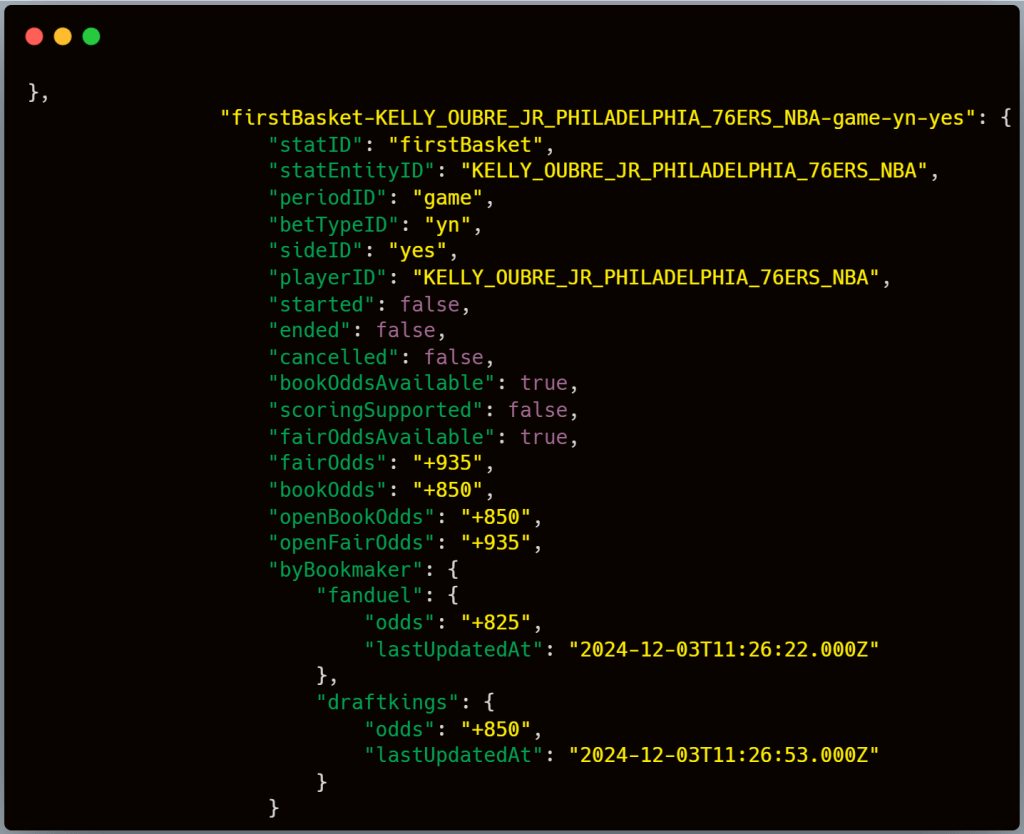
SportsGameOdds offers historical pre-match and in-play odds across major sports and bookmakers, including closing lines, alternate spreads/totals, and player prop outcomes. You can query data per event, per player, or per bookmaker and receive granular results such as past 10–20 games, team-level props, and odds movement.
Historical odds are especially valuable for:
- Validating betting models before going live.
- Analyzing bookmaker line movement.
- Building DFS projection systems.
- Academic or research use cases in sports analytics.
Having this data via API eliminates the need to manually track lines or scrape unreliable sources, giving developers structured, consistent datasets for long-term analysis.
6. How can developers integrate an NFL odds API into their apps? Integrating an NFL odds API usually involves three steps:
- Sign up & get your API key from the provider.
- Make basic queries using REST endpoints or WebSocket streams. For example, calling
/v2/events?leagueID=NFLreturns upcoming games, odds, and available markets. - Filter and optimize queries using parameters like bookmakerID (FanDuel, DraftKings), oddIDs (specific bet types), and includeAltLines or includeOpposingOdds for efficiency.
SportsGameOdds provides Postman collections, code samples, and clean JSON responses, making it straightforward for developers to plug NFL odds into betting apps, DFS platforms, or models.
Best practices include trimming oddIDs to relevant markets, limiting bookmaker requests to those you actually need, and testing WebSocket streams for real-time odds updates. With this setup, developers can build live odds trackers, bet comparison tools, or DFS prop dashboards with NFL coverage in minutes.
Read more: Player prop odds API providers compared | Guide to getting NFL Odds from our odds API | Common Odds API Questions | FAQ on Sports Betting APIs
7. Which odds API is best for daily fantasy sports (DFS) platforms?
DFS platforms thrive on player-level data and prop markets, which makes choosing the right odds API critical. The best DFS odds API will provide:
- Player props coverage (passing yards, goals, strikeouts, etc.).
- Alternate lines for flexible projections.
- Fast updates for real-time contests.
- Historical datasets for backtesting DFS models.
SportsGameOdds covers 28+ sports and 67+ leagues with rich prop markets, alt lines, and historical props. For DFS startups, this means you can offer deeper contests (e.g., “LeBron over 7.5 assists”) and run models with granular inputs.
Other providers may limit props or alt lines, which reduces flexibility. For DFS platforms competing in crowded markets, an API that delivers robust props and historical data is a key differentiator.
8. How do I pull player props and alternate lines using an odds API?
Pulling props and alternate lines depends on the API structure. With SportsGameOdds, you can add query parameters to include these markets:
includeAltLines=true→ fetches alternate spreads/totals.includeOpposingOdds=true→ auto-includes both over/under or yes/no odds when only one side is listed.- Filtering by betTypeID or playerID → lets you isolate specific player markets.
For example, you could call:
/v2/events?leagueID=NFL&includeAltLines=true&bookmakerID=fanduel,draftkings
This returns standard lines plus alternate totals and props.
Be mindful that alt lines and props can increase response size. Best practice: limit queries to relevant oddIDs and bookmakers for faster response times. This makes your DFS or betting app responsive while still providing the depth your users expect.
9. What are the best alternatives to The Odds API or SportsDataIO?
While The Odds API is well-known, many startups look for alternatives due to limited props, slower updates, or high pricing. Alternatives include:
- SportsGameOdds → Fast updates (30–60 sec), props, alt lines, 85+ bookmakers, clear pricing tiers.
- OddsJam API → Focused on arbitrage and sharp betting tools.
- SportsDataIO → Strong sports stats coverage, but higher costs for odds.
- LSports / Sportradar → Enterprise-level feeds, often too expensive for startups.
SportsGameOdds is often chosen by startups and mid-size companies because it balances developer-friendly docs, fast updates, and pricing transparency. For teams that need rich props and alt lines at scale, it’s a strong alternative to The Odds API or SportsDataIO.
10. How accurate and fast are real-time odds APIs compared to bookmaker sites?
Accuracy and speed are critical for odds APIs. A good API should reflect bookmaker site changes within seconds.
SportsGameOdds updates every 30–60 seconds across 85+ bookmakers, which means odds refresh nearly in sync with operator sites. WebSocket connections allow sub-minute updates, making it suitable for real-time betting and DFS contests.
Cheaper or free APIs often have slower refresh cycles (2–5 minutes), which can make them unsuitable for live betting or sharp bettors who rely on line movement.
When evaluating an odds API, ask about:
- Update frequency (seconds vs minutes).
- Bookmaker coverage (sharp books like Circa and Pinnacle — see the Pinnacle Odds API for what that feed returns).
- Data freshness guarantees (uptime SLA, monitoring).
For serious platforms, an API like SportsGameOdds that balances speed, reliability, and breadth of markets is far closer to bookmaker accuracy than free or slower providers.
Choosing the right odds API can make all the difference in building a fast, reliable, and scalable sports betting or fantasy platform. At SportsGameOdds, we’re dedicated to providing developers and businesses with the tools they need — from fast, accurate odds and player props to historical data and deep bookmaker coverage. If you’re ready to explore what an advanced odds API can do for your project, start today with our free tier or sign up for a trial of our Pro plan.
Ready to get started?
Join thousands of developers building the next generation of sports and betting applications.