Optic Odds vs Sports Game Odds: API Comparison (2026)
May 10, 2026
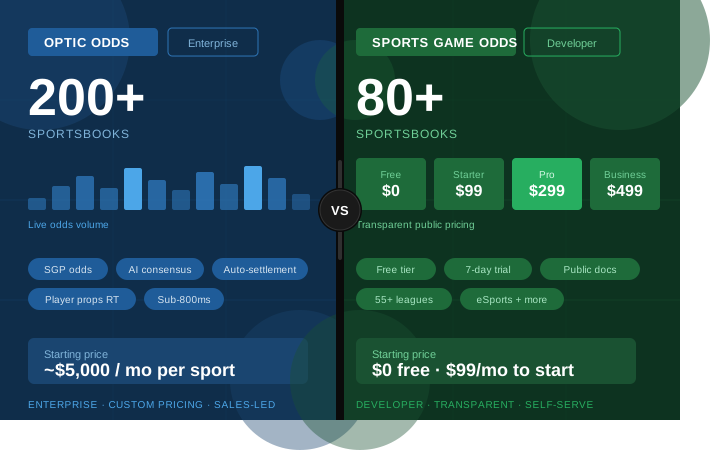
If you are building a sports betting app, odds comparison tool, or analytics platform, choosing the right odds API is one of the most important decisions you will make. Two names that come up consistently in this space are Optic Odds and Sports Game Odds (SGO). Both aggregate real-time odds from multiple sportsbooks, but they serve very different audiences, and understanding that difference could save you thousands of dollars and months of frustration down the line.
This odds API guide walks through both APIs across every dimension that matters: pricing, bookmaker coverage, data quality, developer experience, latency, and more. By the end, you should have a clear sense of which one is the right fit for what you are building.
Quick Summary: Who Are These APIs For?
Optic Odds is an enterprise-grade sports data platform built for trading desks, sportsbooks, and large media companies. It offers a genuinely deep feature set, covering real-time player props, AI-powered consensus pricing, same-game parlay (SGP) data, and automated bet settlement. It is trusted by partners including BetMGM, PrizePicks, and Kalshi. The catch is that it does not publish pricing publicly and requires a sales conversation before you can access anything, which makes it a difficult starting point for anyone without a serious budget already in place as plans start at $5000 per month.
Sports Game Odds (SGO) is a developer-friendly API aimed at indie developers, startups, and mid-size teams. It offers a free tier, publicly listed pricing, a seven-day trial on paid plans, and documentation you can read before signing up for anything. It covers 80 or more bookmakers and 55 or more leagues, making it a solid choice for most production use cases without the enterprise overhead. Plans start at $99 per month and you can upgrade immediately as you scale.
1. Pricing
Pricing is where these two APIs diverge most sharply, and it is the first thing most developers want to know.
Optic Odds Pricing
Optic Odds does not publish pricing on its website. To receive a quote, you need to submit a form asking for your company name, company size, and intended use case. Based on community reports and third-party comparisons, pricing starts at approximately $5,000 per month, with custom enterprise agreements for broader access. There is no free tier and no public trial.
That model is not unusual for enterprise data providers, but it does mean Optic Odds is effectively out of reach for solo developers, small startups, and anyone who needs to validate a business case before committing to a contract. There has been cases where you can trial the API, but you will need to have an established platform in order to convince the sales team you are legitimate.
Sports Game Odds Pricing
SGO uses transparent, publicly listed pricing built around an "objects" billing model. Each event returned in an API response counts as one object. Crucially, all bookmakers and all markets within that event are included at no additional charge, which is a meaningful advantage over credit-based models that charge separately per market queried.
Paid tiers run from $99 to $299 per month when billed annually, or $149 to $499 with monthly billing. A permanent free Amateur tier is available, and all paid plans include a seven-day trial. This structure makes it easy to estimate your monthly costs upfront and to test the API properly before spending anything. SportsGameOdds also offers a custom-priced All-Star tier which adds WebSocket streaming for high-volume and enterprise use.
Verdict: For enterprise operators and trading teams with the budget to match, Optic Odds' custom pricing may well be justified by its feature depth. For everyone else, from side projects to serious startups, Sports Game Odds' transparent and tiered pricing is far more accessible and predictable.
2. Bookmaker Coverage
Optic Odds
Optic Odds aggregates real-time odds from 200 or more sportsbooks worldwide, including major US books such as DraftKings, FanDuel, BetMGM, and Caesars, alongside sharp books like Pinnacle, major European operators, and a wide range of regional books. All data is sourced through direct API integrations rather than scraping, which clients consistently highlight as a differentiator for both data integrity and delivery speed.
Sports Game Odds
SGO covers 85+ bookmakers, including the Pinnacle Odds API, DraftKings, FanDuel, BetMGM, and the major European books as well as prediction markets like Polymarket and Kalshi. That is a meaningful selection for most US and European use cases. However, if your project requires Asian sharp books beyond Pinnacle, such as SBOBet or Singbet, or crypto-native sportsbooks like 1xBet and GG.BET, SGO does not currently cover those markets.
Verdict: Optic Odds wins on raw volume, with more than double the bookmaker coverage. For most developers, SGO's 80-plus books will be sufficient. For operations that need the full global picture, particularly Asian sharp markets, Optic Odds has a clear advantage.
3. Sports and League Coverage
Optic Odds
Optic Odds, who most consider the fastest odds API provider, covers a broad range of sports including American football (NFL and NCAAF), basketball (NBA and NCAAB), baseball (MLB), hockey (NHL), soccer, tennis, cricket, and more. It is particularly strong in US-facing markets and supports live in-play odds across all major sports.
Sports Game Odds
SGO covers 25 or more sports across 55 or more leagues, including NFL, NBA, MLB, NHL, soccer, tennis, MMA, college basketball, college football, handball, and motorsports. That breadth makes it genuinely appealing for platforms serving a diverse international audience beyond the four major North American leagues.
Verdict: Both APIs cover all the major sports comfortably. Where SGO pulls ahead is in niche territory: cricket, handball, and similar markets give it a wider reach for internationally focused or multi-vertical platforms.
4. Market Types and Data Depth
Optic Odds
Optic Odds is consistently described as having one of the most comprehensive market libraries available. Here is what you get out of the box:
- Pre-match moneylines, spreads, and totals
- Live in-play odds
- Real-time player props and alternate markets
- Futures and outright markets
- Same-game parlay (SGP) odds, which remains a rare feature among API providers
- AI-powered consensus pricing that distils data from across all its sources into a single calibrated price per market
- Historical odds for backtesting and model validation
- Automated bet settlement across all outcome types: Won, Lost, Refunded, Half Won, and Half Lost
- Schedules, confirmed lineups, and injury data, all delivered through the same feed
Add all of that together and you start to understand why enterprise operators are willing to pay for it.
Sports Game Odds
SGO's market coverage is solid for most use cases. The core offering includes:
- Pre-match moneylines, spreads, and totals
- Alternate spreads and totals
- Player props and game props
- Live in-play odds via a real-time data stream
- Closing odds, which are particularly useful for model calibration and validation
- Scores and settlement results built directly into the same API response
That last point is worth noting: keeping everything in one response keeps integration clean and reduces the number of calls you need to make. What SGO does not currently support is futures markets, same-game parlay odds, and crypto or niche bookmaker lines.
Verdict: Optic Odds leads significantly here. SGP support, AI consensus pricing, and automated settlement are genuine differentiators for operators building full-featured sportsbook tools or trading infrastructure. For odds comparison sites, EV calculators, and DFS tools though, SGO's market coverage is more than adequate.
5. Real-Time Performance and Latency
Optic Odds
Optic Odds was built by former traders and quants with speed as a core design principle. The platform processes over one million odds per second across hundreds of servers and delivers data in under 800ms. It supports a Server-Sent Events (SSE) streaming endpoint for real-time odds updates, which makes it well suited to live in-play markets. Rate limits are generous at up to 2,500 requests per 15-second window for standard endpoints. The platform does not currently offer WebSockets.
Sports Game Odds
SGO offers a real-time data stream for live odds and achieves sub-minute update frequency for pre-match markets. SSE streaming is available on higher-tier plans. For the majority of use cases, including odds comparison dashboards and EV tools, that update cadence is more than sufficient. For ultra-low-latency trading applications where milliseconds genuinely matter, Optic Odds holds a clear technical edge.
Verdict: Optic Odds is the faster platform for high-frequency, latency-sensitive applications. For the vast majority of production use cases, SGO's update speed is entirely workable and will not be a limiting factor.
6. Developer Experience
Optic Odds
Optic Odds provides well-structured documentation and a public developer FAQ. The API returns data in JSON or XML and is described by customers as straightforward to integrate, with some teams going fully live within 48 hours of starting. The limitation is that documentation is gated behind a sales engagement, and there is no public sandbox or free trial to test against before that conversation happens. Support is delivered through a dedicated sales and account management relationship, which works well once you are a customer but creates friction before you get there.
Sports Game Odds
SGO positions itself explicitly as developer-first. Documentation is publicly accessible without an account, setup takes roughly five minutes, SDKs are available for faster integration, and the free tier means you can have real data flowing into a local environment before committing to anything. Community reviews consistently describe the onboarding experience as smooth and well supported.
Verdict: SGO wins comfortably on accessibility. The ability to read the docs, spin up a free account, and make real API calls before ever talking to a salesperson is a substantial advantage, especially during the evaluation and prototyping stage.
7. Target Audience and Use Cases
| Use Case | Better Fit |
|---|---|
| Enterprise sportsbook or trading desk | Optic Odds |
| Media company or large odds comparison site | Optic Odds |
| Daily fantasy sports platform (DFS) | Optic Odds |
| Applications needing SGP odds | Optic Odds |
| Startup or indie developer | Sports Game Odds |
| Odds comparison tool or EV calculator | Sports Game Odds |
| Bet tracker or picks platform | Sports Game Odds |
| Discord bots and personal dashboards | Sports Game Odds |
| Academic or quantitative research | Sports Game Odds |
| Applications needing eSports or motorsports | Sports Game Odds |
8. Key Questions to Ask Before Choosing
What is my budget?
This is often the deciding factor before anything else.
- Under $500 per month: SGO is the clear choice, with transparent tiered plans and no sales process to navigate.
- $5,000 or more per month: Optic Odds unlocks considerably more capability and is designed for that level of spend.
Do I need same-game parlay data?
SGP odds are genuinely rare among API providers. If your product depends on SGP markets, Optic Odds is one of the very few options that supports this, so it may not be much of a choice.
How important is bookmaker breadth?
- For US and major European coverage, 80-plus books is usually more than enough, and SGO handles that well.
- If you need Asian sharps like SBOBet and Singbet, or crypto books, Optic Odds is the only one of the two that covers that ground.
Do I need to test before committing?
SGO offers a free tier and a seven-day trial, meaning you can validate the data and build a working prototype before spending anything. Optic Odds requires a sales conversation first, which is fine if you are already at that stage, but adds friction if you are still evaluating.
How latency-sensitive is my application?
- Passive odds comparison tools, content sites, or model research: either API will perform well.
- High-frequency arbitrage scanners or live trading tools where sub-second updates are critical: Optic Odds' infrastructure is built for exactly that.
Do I need automated bet settlement?
Optic Odds grades bets automatically in real time across all outcome types. SGO includes settlement results in its data, but the fully automated grading layer is an Optic Odds differentiator for operators running active bet platforms.
What sports and leagues do I need?
Both APIs cover all major North American and European sports without issue. For eSports, cricket, handball, and niche leagues, SGO offers wider declared coverage and is likely the better fit.
9. Side-by-Side Comparison Table
| Feature | Optic Odds | Sports Game Odds |
|---|---|---|
| Pricing | Custom (from ~$5,000/mo per sport) | $99 to $499/mo (billed annually) |
| Free Tier | No | Yes (Amateur tier) |
| Free Trial | No | 7 days on paid plans |
| Public Pricing | No | Yes |
| Bookmaker Coverage | 200+ | 80+ |
| Sports Coverage | 20+ | 28+ sports, 67+ leagues |
| Player Props | Yes (real-time) | Yes |
| Live In-Play Odds | Yes | Yes |
| Futures Markets | Yes | No |
| Same-Game Parlays | Yes | No |
| Historical Odds | Yes | Yes (varies by tier) |
| Closing Odds | Yes | Yes |
| AI Consensus Pricing | Yes | No |
| Automated Bet Settlement | Yes | Partial (results included) |
| Schedules and Lineups | Yes (within same API) | Yes |
| Streaming (SSE) | Yes | Yes (higher tiers) |
| WebSocket | No | No |
| Data Format | JSON and XML | JSON |
| Latency | Sub-800ms | Sub-minute (pre-match) |
| Documentation Access | Post-sales | Public |
| SDKs | Yes | Yes |
| Target Audience | Enterprise and Trading Desks | Developers, Startups, Fantasy Apps |
10. The Bottom Line
Choose Optic Odds if you are an enterprise operator, sportsbook, trading desk, or large media company that needs the deepest market coverage available, requires SGP data, wants AI-calibrated consensus pricing, or operates at a scale where the cost is justified. The platform is trusted by some of the biggest names in the industry, and that reputation is not accidental.
Choose Sports Game Odds if you are a developer, startup, or growing team that needs reliable odds data across 80-plus books and 55-plus leagues, values transparent and predictable pricing, and wants to test the product before committing any budget. For the vast majority of sports betting apps, odds comparison tools, and analytics platforms, SGO delivers excellent value at a fraction of the cost and without the enterprise sales process standing between you and your first API call.
Read More: Alternative to the Odds API | All head-to-head comparisons
Ready to get started?
Free tier, no credit card, no sales call. Compare the data yourself.