Odds API for AI Betting Apps
November 10, 2025
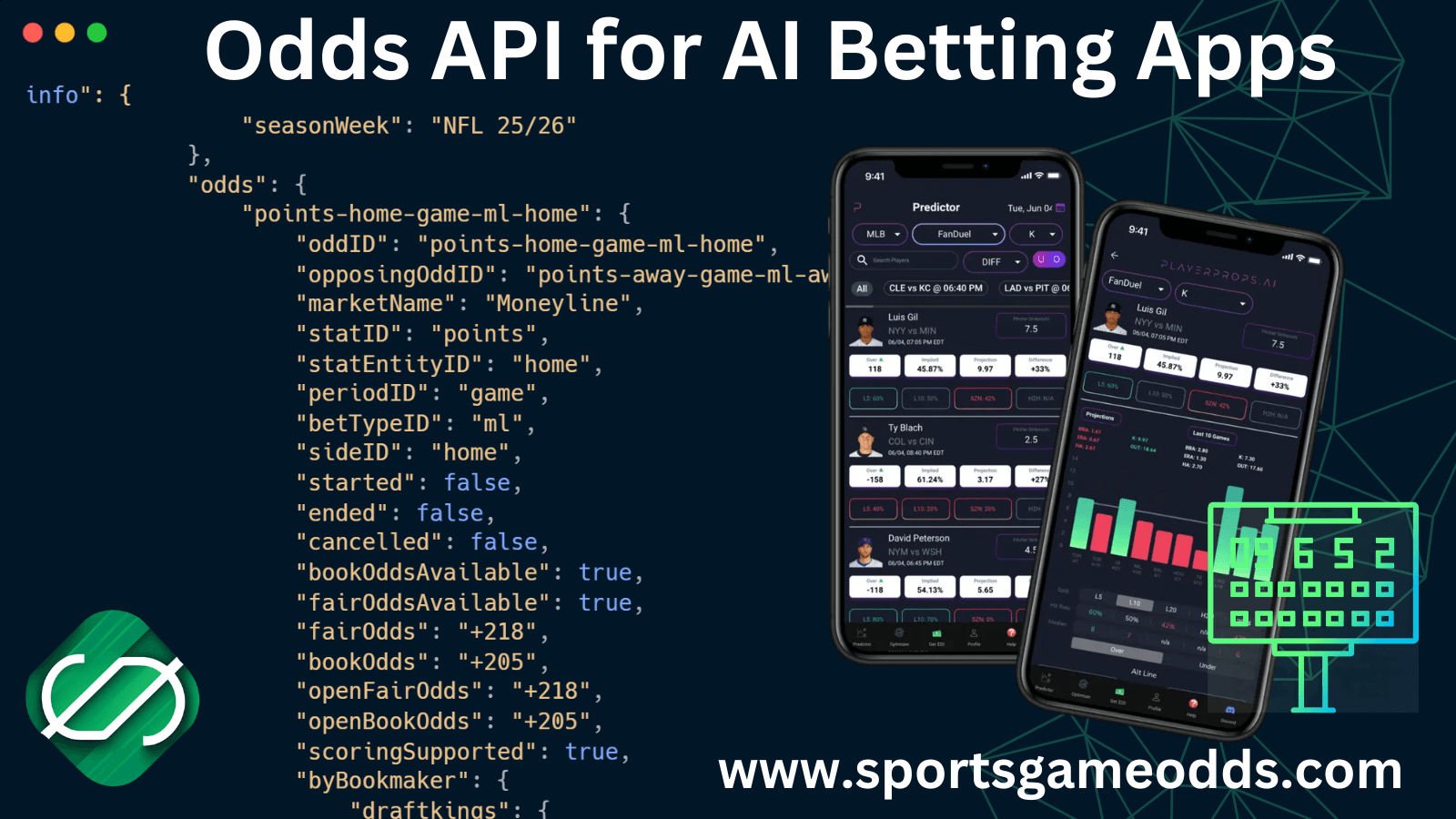
Odds API for AI Betting Apps
AI betting apps depend on one thing above everything else: developer friendly, structured, and continuously updated odds data. Whether you’re building an AI pick generator, a predictive model, an arbitrage analysis app, or a fully automated betting assistant, the underlying Odds API determines your model accuracy, latency, and competitive edge.
What Developers Need to Know when choosing an Odds API for AI betting platforms
This guide explains what AI betting apps require from an Odds API, what features to prioritise, what potential issues to avoid, and how SportsGameOdds provides a complete, developer-friendly solution.
Why AI Betting Apps Need a Reliable Odds API
AI-driven betting platforms and tools require consistent, structured, and accurate odds data. Use cases include (and see the full use-case library for worked examples):
- Feeding machine-learning models
- Generating AI-powered picks and recommendations
- Real-time line movement monitoring
- Calculating consensus odds
- Predicting price shifts or identifying value bets
- Dynamic bankroll management and automated staking systems
- Automated grading and result prediction modelling
- DFS lineup optimisation
Platform and model accuracy is directly related to data quality. Low-quality or delayed data produces weak predictions, failed automations, and poor user trust. A strong, accurate Odds API is the base layer of any successful AI betting platform.
Key Data Features AI Apps Should Look For
1. Detailed Market Depth AI systems perform better with granular inputs. Look for:
- Player props
- Alt-lines
- Derivatives
- Totals
- Team props
- Line movement timestamps
- Consensus odds
- Market availability status
The more signal-rich the data, the stronger the platform and model can be.
2. Extensive Bookmaker Coverage AI apps and EV tools thrive on the diversity of pricing. You ideally want:
- All major U.S. books
- Secondary books for market inefficiency detection
- Niche international books for volume diversity
- Consistent IDs across books
More bookmakers equals more signals and better AI accuracy and more opportunities for finding value and the best picks.
3. High Update Frequency AI systems often run in continuous loops. You need:
- 30–60 second REST update cycles
- WebSocket access for streaming odds( this will come with the relevant price tag)
- Timestamps for every update(such as “”lastUpdatedAt”: “2025-07-16T19:32:43.236Z”,
- Clear indicators when markets open, move, or suspend
"odds": {
                "points-home-game-ml-home": {
                    "oddID": "points-home-game-ml-home",
                    "opposingOddID": "points-away-game-ml-away",
                    "marketName": "Moneyline",
                    "statID": "points",
                    "statEntityID": "home",
                    "periodID": "game",
                    "betTypeID": "ml",
                    "sideID": "home",
                    "started": false,
                    "ended": false,
                    "cancelled": false,
                    "bookOddsAvailable": true,
                    "fairOddsAvailable": true,
                    "fairOdds": "-105",
                    "bookOdds": "-116",
                    "openFairOdds": "-105",
                    "openBookOdds": "-116",
                    "scoringSupported": true,
Sub-minute updates are more than enough for predictive analysis without overloading your servers. Often the best opportunities are available a few days out from the games when the markets open.
4. Historical Odds Depth This is the backbone of training any AI model. Ensure your provider offers:
- Multi-season historical data
- Historical player props
- Full alt-line history
- Final scores and event results
- To determine outcomes for a given odds market we recommend looking at the “score” field on that odds market. That can be found at odds.<oddID>.score. You can also see whether we will end up providing scores on a given odds market by checking the scoringSupported field (odds.<oddID>.scoringSupported). The results object holds the “raw” score data which isn’t as helpful when scoring odds markets as the dedicated score field is. We also typically recommend waiting until the event is finalized (status.finalized == true) to finalize your scores. You can certainly start scoring things as soon as the event is ended (status.ended == true) if you want, but by waiting until it’s finalized (usually up to an hour after it ends), that gives our system time to perform additional verifications and reduce the chances of a later stat correction.
- Consistent team/player IDs
passing_yards-JALEN_HURTS_1_NFL-game-ou-over": { "oddID": "passing_yards-JALEN_HURTS_1_NFL-game-ou-over", "opposingOddID": "passing_yards-JALEN_HURTS_1_NFL-game-ou-under", "statID": "passing_yards", "statEntityID": "JALEN_HURTS_1_NFL", "periodID": "game", "betTypeID": "ou", "sideID": "over", "playerID": "JALEN_HURTS_1_NFL", "started": false, "ended": false, "cancelled": false, "bookOddsAvailable": true, "fairOddsAvailable": true, "fairOdds": "+100", "bookOdds": "-114", "fairOverUnder": "202.5", "bookOverUnder": "197.5", "openFairOdds": "+100", "openBookOdds": "-114", "openFairOverUnder": "202.5", "openBookOverUnder": "197.5", "scoringSupported": true,
Without these, your model will either underfit or rely on incomplete data.
Read More: Vibe coding with the odds API | What people are building with the API
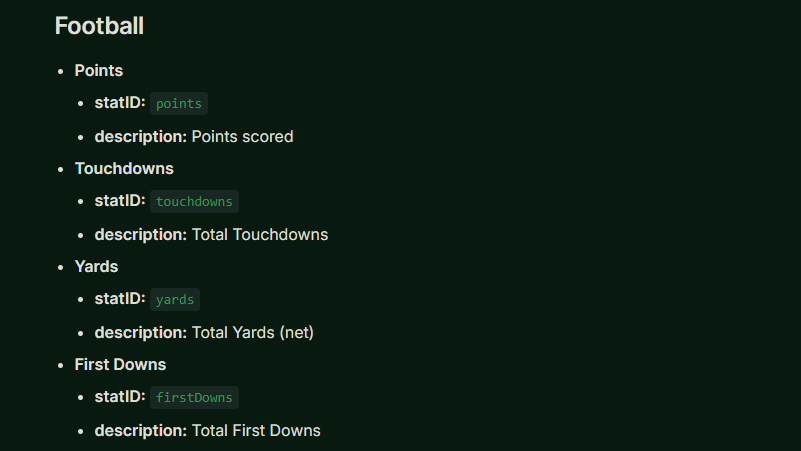
5. Clean, Developer-Friendly Structure
AI betting and prediction apps need structured, well-formatted data.
The API should provide:
- Normalised fields across sports
- Consistent naming conventions (such as “statID”: “touchdowns”)
- Clear IDs for players, teams, and markets (such as “marketName”: “Jalen Hurts Passing Yards Over/Under”)
- Easy filtering (league, sport, date, oddID, bookmaker, such as “oddID”: “passing_yards-JALEN_HURTS_1_NFL-game-ou-under”,
Clean, well-structured data reduces preprocessing time, improves model performance, and speeds up development.
View our API documentation for the markets covered, statIDs and oddIDs we support.
How to Evaluate an Odds API for AI Use Cases
Use this AI-specific evaluation list:
- Does the API include player props and alt-lines?
AI models perform significantly better when they have access to granular markets like props and alt-lines, which carry far more predictive signal.
- Are timestamps included for every odds update?
Precise timestamps allow your model to track market movement, volatility, and timing, which are essential for training and real-time triggers.
- Does the provider support a number of bookmakers?
The more sportsbooks included, the richer the dataset becomes—improving consensus accuracy, arbitrage detection, and price-inefficiency modelling.
- Are IDs consistent across sports?
Stable, normalised IDs reduce preprocessing time and prevent mismatches when building multi-sport models or merging datasets.
- Can data be stored locally for modelling?
AI workflows depend on storing and replaying large datasets, so the provider must allow internal archiving for model development.
- Are update frequencies predictable?
AI systems and platforms rely on consistent refresh patterns; unpredictable or slow cycles lead to unreliable modelling and poor real-time decisions.
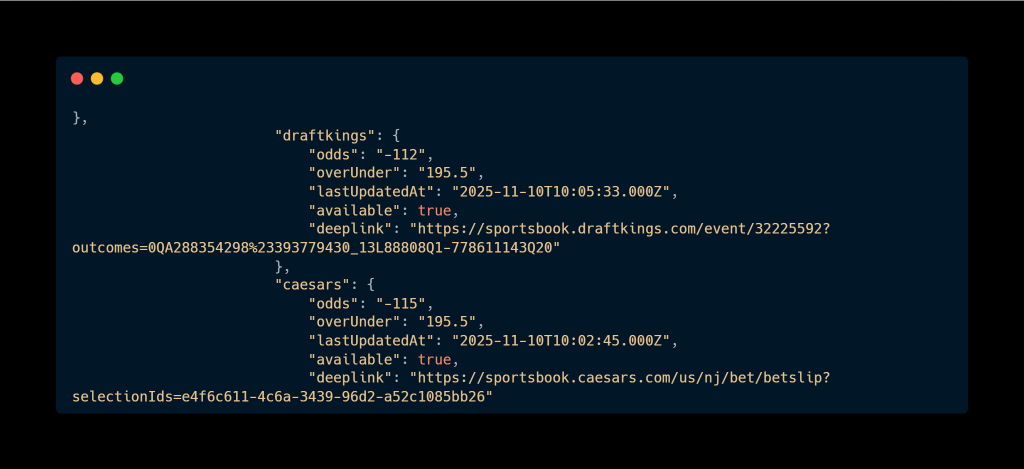
- Does the API include deep linking?
Deep links are valuable for user-facing apps, enabling quick transitions from AI-generated insights to verified sportsbook pages.
For AI systems, consistency and completeness matter more than raw speed.
Common Pitfalls AI Betting Apps Should Avoid
Many providers appear AI-ready but fall short. Watch out for:
- No player props or alt-lines
- Missing update timestamps
- Slow REST updates (3–10 minutes)
- No historical prop data
- Inconsistent IDs
- No market suspension indicators
- Limited sportsbook list
- Expensive enterprise-only plans
- Hidden cost for historical access
These issues will cripple model training and lead to unreliable predictions.
Why AI Developers Choose SportsGameOdds
SportsGameOdds provides the ingredients AI betting models need:
- Coverage for 67+ leagues and 85+ bookmakers
- Deep data for player props, alt-lines, and derivative markets
- 30–60s REST update frequency
- ~45s WebSocket feed for continuous ingestion
- Full bookmaker + event-level deeplinks
- 5–20+ years of historical odds (league-dependent)
- Stable team and player IDs
- Normalised data structures across sports
- Predictable object-based pricing
- Free tier for prototyping
- SDKs for JavaScript/TypeScript, Python, Go, Ruby, Java
This combination gives AI startups the structure, depth, and affordability needed to build accurate predictive systems.
Example API Requests for AI Workflows
Historical line movement for training (NBA player props)
Live line monitoring for real-time AI predictions
[https://api.sportsgameodds.com/v2/events?apiKey=YOUR_KEY&leagueID=NFL&startsAfter=NOW&includeAltLine=true](https://api.sportsgameodds.com/v2/events?apiKey=YOUR_KEY\&leagueID=NFL\&startsAfter=NOW\&includeAltLine=true)
These requests power:
- Real-time prediction engines
- AI pick suggestions
- Arbitrage detection
- Automated grading logic
Integration Paths for AI Betting Apps
AI-focused products typically take one of three approaches:
1. REST Polling (most common for prototypes)
- Easy to implement
- Predictable update cycles
- Good for gathering training data or per-minute refreshes
2. WebSocket Streaming
- Best for real-time dashboards and model triggers
- Useful for continuous ingestion of price movements
- SGO WebSocket runs on a ~45 second delay
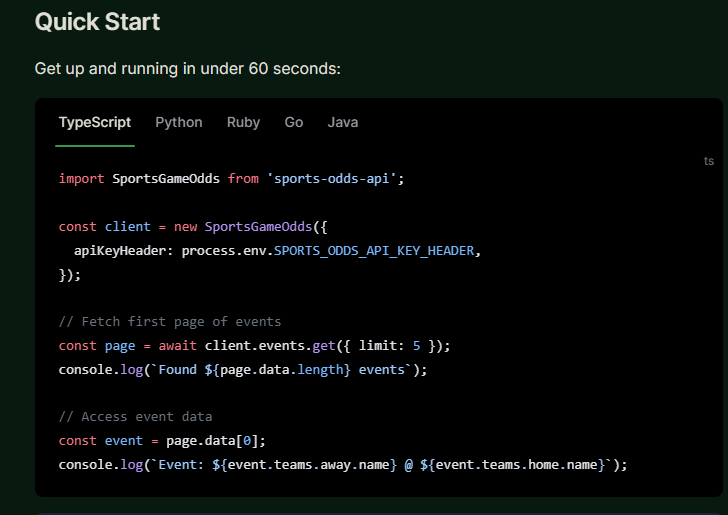
3. SDKs for Cleaner Code
SGO SDKs simplify ingesting and structuring odds data using:
- JavaScript/TypeScript
- Python
- Go
- Ruby
- Java
Ideal for ML pipelines and automated ingestion scripts.
AI-Focused Legal Considerations (Non-Legal Summary)
AI betting apps should confirm:
- Whether odds can be stored long-term
- Whether redistribution is allowed
- Whether automated betting is permitted in their region
- Compliance with local betting/licensing laws
- Data usage limits under each plan
This is not legal advice—just a reminder to review your obligations.
Frequently Asked Questions (AI Version)
Does SGO support training datasets for AI models? Yes—historical data can be used for modelling and analysis.
Can I store and preprocess odds offline? Yes, internal storage and analytics are allowed on paid plans.
Does SGO support timestamps for line movement? Yes—each odds update includes an ISO timestamp. For example “lastUpdatedAt”: “2025-11-10T10:02:45.000Z”.
Is WebSocket needed for AI? Only for real-time dashboards or intraday prediction systems. REST is enough for most training, modelling and EV+ apps.
Does the API include player props and alt-lines? Yes, across all major supported leagues.
Conclusion
AI betting apps require clean, structured, fast, and historically rich data. The strength of your ML or predictive engine depends entirely on the quality of the odds data beneath it. With broad coverage, deep historical datasets, consistent update cycles, and developer-friendly odds API SDKs, SportsGameOdds offers a complete solution for AI-driven betting applications.
Ready to get started?
Join thousands of developers building the next generation of sports and betting applications.