Common Odds API questions
August 8, 2025 · Updated July 31, 2026

Common Odds API questions
Here is a list of questions that are related to Odds API providers
What is an Odds API?
An Odds API is an application programming interface (API) that delivers real-time or historical betting odds data for events like sports games, elections, or other outcomes. It’s essentially a tool developers use to integrate this data into betting apps, websites, or analytics platforms, making it easier to build features like live betting trackers or predictive models.
Is there a free odds API?
Yes. SportsGameOdds has a permanently free Amateur tier — 2,500 objects a month, no credit card and no expiry — and The Odds API offers a free plan too. Free tiers do come with restrictions, typically request limits, a slower update frequency, or narrower league and bookmaker coverage. They are ideal for building and testing, though most will not suit high-volume or live-trading requirements. See pricing for what each tier includes.
Read More: Best Free Sportsbook APIs
What is the difference between a Betting API and an Odds API?
Sometimes, these terms can be used interchangeably, but in the betting industry, there are some notable differences.
An Odds API is primarily focused on delivering data about betting odds, such as current odds and markets for events like sports or elections, making it ideal for data analysis for models or displaying on websites. A Betting API, on the other hand, is broader and often includes functionality for placing actual bets, managing user accounts, processing payments, and integrating with betting platforms. The key difference is that Odds APIs are more about retrieving information, while Betting APIs enable interactive actions.
In short:
- Odds API: Gives you the odds data from many sources.
- Betting API: Lets you place bets with one specific bookmaker.
Who are the best Odds API providers?
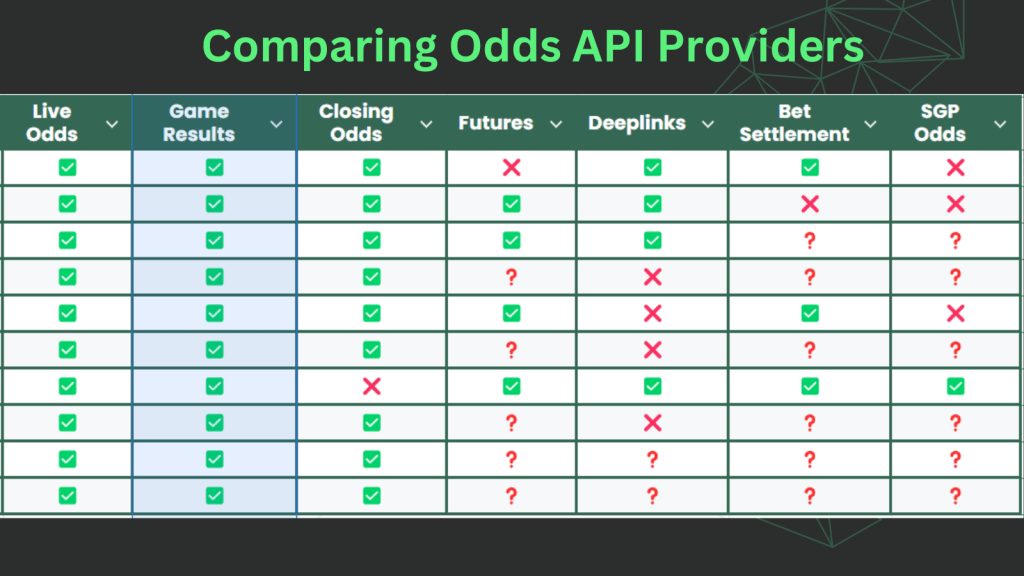
The “best” Odds API providers depend on your requirements, like your budget, data coverage, how quickly you need the odds, and your use case. Based on reliability and popularity, here are a few top ones:
- SportsGameOdds: A developer-first odds API covering 67+ leagues and 85+ sportsbooks. One request returns a game's whole odds tree — moneylines, spreads, totals, alternate lines and player props — and billing is per event rather than per market, so pulling every market for a game costs the same as pulling one. Scores, results and settlement data are included on every plan, and there is a permanently free tier.
- The Odds API: Great for beginners with a free tier, offering real-time odds for sports and events—super accessible and easy to integrate.
- Sportradar: A leader in comprehensive sports data, with high accuracy and extensive coverage, ideal for professional apps or analytics.
Read More: 5 of the Best Odds API for Betting Platforms
What should I look for when choosing an Odds API?
Here are a few key things to consider when choosing an odds API:
- Coverage: Make sure it includes the sports, events, or markets you need—some APIs are niche, while others are broad. Do you need player props for MLB, historical data for NFL, first goal scorer for soccer?
- Data Freshness: Look for real-time or near-real-time updates if you’re building live features; or if you’re just looking for pre-match opportunities, then delayed data will be adequate.
- Pricing and Cost: Check if the cost fits your budget—free tiers are great for testing, but paid plans often offer more reliability and limits. There is a direct correlation between coverage, speed and cost!
- Ease of Integration: A well-documented API with SDKs or clear examples saves tons of development time. Some APIs offer Postman collection to get you started quickly.
- Reliability & Support: Go for providers with a solid uptime record and responsive customer service for when things go sideways. Look for direct email addresses, Discord communities or even a phone number.
If you think about your project’s specific goals, and you’ll narrow it down fast.
Read More: Player prop odds API provider guide | Choosing an Football Odds API Provider | SportsGameOdds FAQ | FAQ on Sports Betting APIs
How fast are Odds API updates?
The speed of updates depends on the provider and the delivery method. Most REST-based Odds APIs update every 30–60 seconds, which is sufficient for pre-match odds and slower-moving markets. For live, in-play betting, faster updates are critical. Some APIs offer WebSockets, which push odds changes in near real-time (sub-30 second latency), making them better suited for arbitrage tools, live trackers, and advanced modeling. Always check refresh frequency before committing to a provider.
Can I scrape the bookmaker myself for my odds API?
Scraping a bookmaker’s website for odds data to build your own API is technically possible, but it comes with some challenges and potential risks. Here’s what you need to consider:
Legal Concerns
This is the most important point. Virtually every bookmaker’s website has a “Terms of Service” (ToS) agreement that you implicitly accept by using their site. These terms often forbid any form of automated access, data scraping, or screen scraping. Violating the ToS can lead to:
- IP Ban: Your server’s IP address (and potentially your personal one) will be permanently blocked.
- Account Termination: If you are logged in, your account will be shut down.
- Legal Action: While rare for small-scale scraping, they are within their rights to send a cease-and-desist letter or take further legal action.
Technical Skills and maintenance
Scraping requires programming know-how, using tools like Python with libraries such as BeautifulSoup or similar to extract data from web pages. These sites often have complex, dynamic content , so you might need tools like Selenium to handle that.
If you get that right, then you will need to look at data parsing as odds data isn’t always neatly structured, so you will need to standardize the data for API use.
Lastly, websites update their layouts frequently, breaking scrapers. You will need to constantly tweak your code to adapt.
While technically possible, scraping bookmakers for odds data is risky, unreliable, potentially illegal, and hard to maintain. It’s usually smarter to leverage an established Odds API.
Do Odds APIs support WebSockets or just REST?
Odds APIs typically offer two main integration methods:
- REST Endpoints: Ideal for historical data, pre-match queries, or low-frequency odds checks. Developers make pull requests when they need fresh data.
- WebSockets: Better for real-time scenarios. Odds are pushed directly to your application whenever they change, eliminating the need for constant polling.
If your project involves in-play odds, alerting systems, or high-frequency trading, WebSockets are usually a must-have.
What are some issues with Odds API providers?
There are several common issues you might encounter with Odds API providers. Here are some common issues to watch out for:
- Data Accuracy and Delays: Odds can change rapidly, so providers might have delays in updates or occasional inaccuracies, which could affect live applications or decisions based on outdated info.
- Rate Limits and Restrictions: Free or basic plans often cap the number of requests per day, leading to incomplete data or downtime in high-traffic scenarios—upgrading to paid plans might be necessary for scalability.
- Coverage Gaps: Not all APIs cover every sport, event, or region, so you might miss key data if your focus is niche or international, requiring multiple sources to fill in.
- Legal and Regulatory Hurdles: Betting-related APIs can face compliance issues with gambling laws in different countries, potentially limiting accessibility or requiring extra steps for data usage.
- Technical Reliability: Problems like API downtime, poor documentation, or integration bugs can frustrate developers, especially if support is slow to respond.
- Cost and Value: Pricing can escalate quickly, and some providers might not deliver proportional value, leading to hidden fees or underwhelming features.
That said, many of these issues can be mitigated by choosing a reputable provider and testing thoroughly before signing up.

What Odds API provides historical odds data?
Historical coverage and data can vary significantly across API provider and packages they offer. Some my go back decades and cover player props, players stats and closing odds.
Here is a list of provider that offer Historical Odds Data.
1. OddsJam
- Historical Data? Yes (premium/enterprise plans).
2. Sportradar / Betradar
Historical Data? Yes (enterprise level).
3. SportsGameOdds
- Historical Data? Yes, on paid plans and 1 week free on free packages.
4. The Odds API
- Historical Data? Yes, through dedicated API endpoints. Limited to paid plans.
Can I get player props and alternative lines (alt lines) through an Odds API?
Yes, some Odds APIs provide access to more advanced betting markets like player props (e.g., “LeBron James over 25.5 points”) and alternative lines (e.g., spreads/totals beyond the standard market, such as “Over 2.75 goals” in soccer). Not all providers offer these, and when they do, props and alt lines often increase data size and response times. If your use case relies heavily on props or niche markets, confirm they’re supported before you choose a provider.
Do odds API providers offer deeplinks?
The availability of deeplinks depends on the specific Odds API provider and their partnerships or business model. SportGameOdds.com offer deeplinks for several bookmaker and markets.
Odds API Update. You’ll now see expanded deeplinking support across more bookmakers. In addition, we’ve introduced event-level deep linking on the majority of the 80+ bookmakers we support—currently active on 50+ and counting.#oddsapi #SportsGambling #bettingodds #bettingpicks… pic.twitter.com/iYodjaBrwO
— Sports Game Odds API (@SportsGameOdds) June 10, 2025
What programming languages do Odds API providers support?
Odds API providers focus on delivering data via standard web protocols (HTTP/HTTPS), so they’re compatible with virtually any modern programming language.
Most providers will support the following:
- Python: Widely supported due to its popularity in data handling and web development. Libraries like requests make API integration trivial, and many providers (e.g., The Odds API and SportsGameOdds) offer Python code snippets in their docs.
- JavaScript/Node.js: Essential for web-based betting platforms, JavaScript (especially via Node.js with packages like axios or fetch) is often supported with examples or SDKs. Great for real-time updates using WebSockets.
- Java: Common for enterprise-level or Android app development. Providers like Sportradar often provide Java SDKs or examples using libraries like OkHttp or Retrofit.
- PHP: Frequently used for server-side web apps, PHP is supported by many providers with code samples or libraries (e.g., using cURL or Guzzle for requests). The Odds API and Betfair have PHP examples.
- Ruby: Supported by some providers with examples using libraries like HTTParty. It’s less common but still viable for web platforms.
Can I use python to integrate an odds API with my betting platform?
Yes, you can definitely use Python to integrate an Odds API with your betting platform,website or tool. Python is a fantastic choice due to its simplicity, versatility, and strong library support.
Do Odds APIs provide results and settlements, or only odds?
Many Odds APIs focus primarily on live and pre-match odds, but some also include final results, scores, and settlement data. This is particularly useful for applications that need to track performance, validate bets, or automate payouts in fantasy or betting apps. APIs that provide both odds and results streamline development, saving you from sourcing scores separately.
What is the difference between free and paid odds APIs?
Free odds APIs are great for testing, prototypes, or hobby projects. They usually come with limitations such as:
- Lower request limits (e.g., 100 calls/day)
- Delayed or partial data
- Limited sports or bookmakers covered
Paid plans, on the other hand, typically unlock:
- Higher or unlimited request limits
- Real-time, accurate data
- Wider coverage of sports, bookmakers, and markets
- Access to premium features like WebSockets, player props, or historical data
- Priority support
If you’re running a commercial project, a paid plan is almost always required.
Ready to get started?
Join thousands of developers building the next generation of sports and betting applications.