Polymarket, Kalshi & Aggregator APIs: Advanced Developer Guide
April 13, 2026
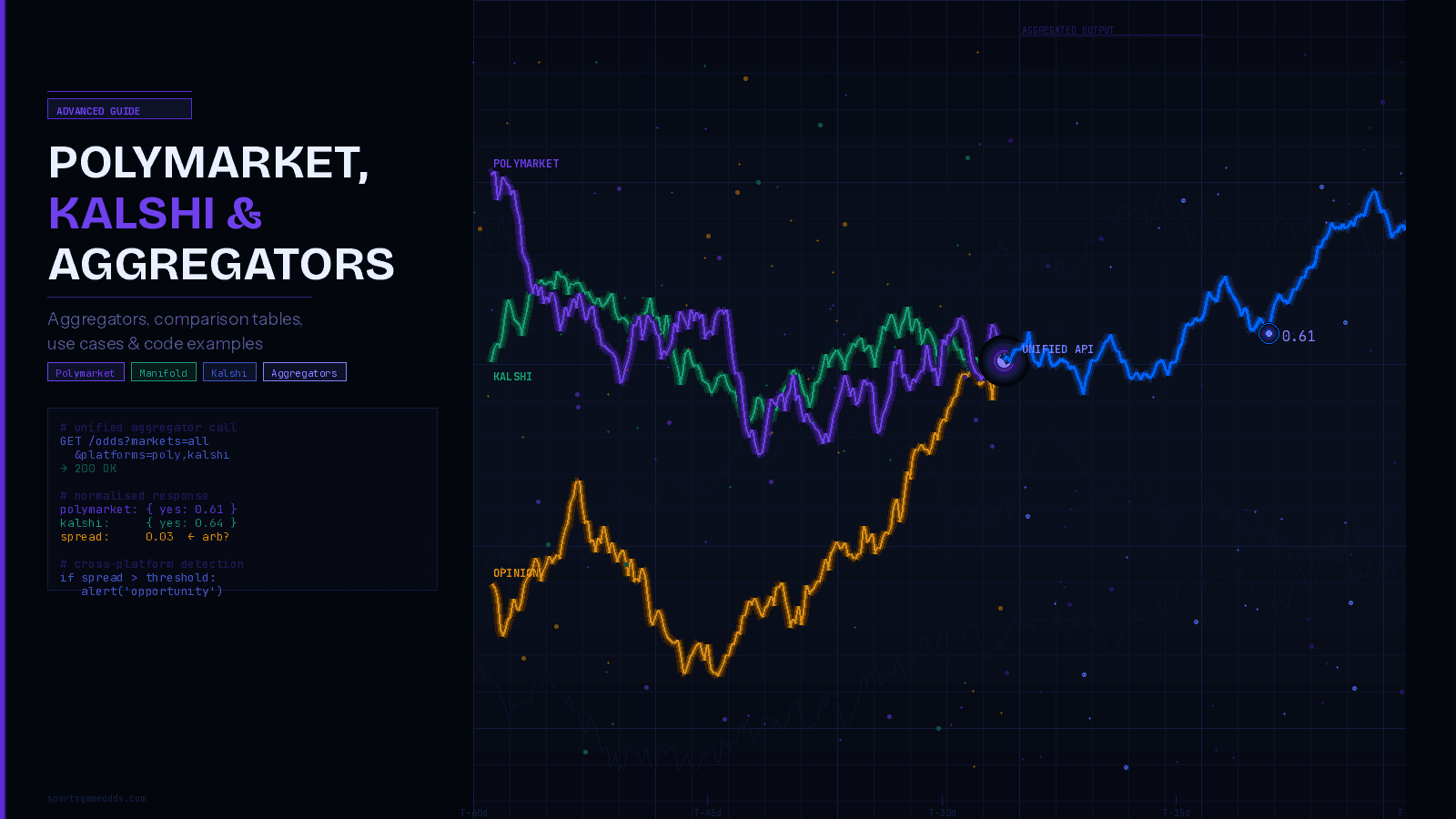
This is part two of the SportsGameOdds prediction market API series. Part one covers the fundamentals and the Kalshi API in depth. This guide picks up from there: Polymarket, Manifold Markets, unified aggregators, a full platform comparison, practical use cases, and how prediction market APIs stack up against traditional sportsbook odds feeds.
New to prediction market APIs? Start with the beginner's guide: What Are Prediction Market APIs? A Beginner's Guide.
1. Polymarket API: blockchain-native, high volume
Polymarket is the largest prediction market by trading volume, processing billions in monthly trades across thousands of active markets. It runs on Polygon (an Ethereum Layer 2 network) and settles in USDC. The API architecture is fundamentally different from Kalshi's. Reading data is straightforward and requires no authentication, but placing trades means interacting with smart contracts and signing EIP-712 typed data with a crypto wallet.
That might sound intimidating if you come from a traditional backend background, but for data and display purposes you can ignore all of that. The public read endpoints work like any REST API.
The CLOB API
Polymarket's main trading interface is the Central Limit Order Book (CLOB) API, hosted at clob.polymarket.com. The good news is that public endpoints for reading market data need no authentication at all. You only need wallet-based auth when you want to execute trades.
# Polymarket CLOB API: fetch live market prices, no auth required
import requests

BASE = "https://clob.polymarket.com"

# Grab the full market list
markets = requests.get(f"{BASE}/markets").json()

# Fetch the order book for a specific market
condition_id = "0xabc123..."  # replace with a real condition_id
book = requests.get(
    f"{BASE}/book",
    params={"token_id": condition_id}
).json()

print(f"Best bid: {book['bids'][0]['price']}")
print(f"Best ask: {book['asks'][0]['price']}")
The Gamma Markets API
Polymarket also has a second API layer called the Gamma Markets API, hosted at gamma-api.polymarket.com. This one sits at a higher level and gives you event titles, descriptions, resolution criteria, and category metadata. It is the right starting point if you are building a discovery feature or a search interface rather than a trading tool.
WebSocket streaming
For real-time feeds, connect to Polymarket's WebSocket API at ws-subscriptions.clob.polymarket.com. You subscribe to channels for specific markets and receive price updates, trade notifications, and order book diffs pushed directly to you as they happen. No polling required.
No geographic restrictions: Polymarket data is openly accessible from anywhere in the world. US residents are currently excluded from trading, but anyone can read market data freely.
2. Manifold Markets API: the best place to learn
Manifold Markets runs on a play-money currency called Mana rather than real USD, which means there is zero financial risk and no compliance headache. It also has some of the most relaxed rate limits and simplest authentication of any prediction market platform. Public endpoints need no authentication whatsoever, which makes it a genuinely pleasant place to start.
// Manifold Markets: fetch markets, no auth required
const res = await fetch(
  'https://api.manifold.markets/v0/markets?limit=5&sort=lastUpdatedTime'
);
const markets = await res.json();

markets.forEach(m => {
  console.log(m.question, '->', m.probability);
});
The full API documentation lives at docs.manifold.markets/api and covers markets, bets, user profiles, and topic data. Honestly, if you are new to prediction markets, spending an afternoon with the Manifold API before tackling Kalshi or Polymarket will save you a lot of time. The data shapes are similar enough that the skills transfer directly.
3. Unified aggregator APIs
Managing separate integrations for Kalshi Odds API, Polymarket Odds API, and other platforms is a significant engineering overhead. You are dealing with different authentication schemes, different data schemas, different rate limits, and different WebSocket protocols all at once. A new category of unified aggregator APIs has emerged to solve exactly that problem.
What aggregators give you
- A normalised schema: one consistent JSON format regardless of which platform the data came from, so you do not rewrite your parser for every source.
- Single authentication: one API key covers multiple exchanges rather than managing RSA key pairs and wallet signatures across platforms.
- Cross-platform search: find equivalent markets across platforms in a single call, which is essential for arbitrage or comparison tools.
- Consolidated historical data: trade history that would otherwise require scraping multiple sources independently.
The main aggregators in 2026
FinFeedAPI covers Polymarket, Kalshi, Myriad, and Manifold Markets through a single endpoint. If you need cross-platform price data without managing multiple integrations, this is a solid starting point.
PolyRouter provides normalised data from Kalshi, Polymarket, Limitless, and several other platforms through a single API key. The schema is consistent across sources, which makes it straightforward to build comparison tools on top of.
Prediction Hunt v2 API emerged after Polymarket acquired Dome (a YC-backed aggregator) in early 2026, leaving a gap for independent cross-platform data. It now covers Polymarket, Kalshi, Opinion, and Predict.fun.
SportsGameOdds takes aggregation further by combining prediction market data from Polymarket and Kalshi with traditional sportsbook odds from 85+ bookmakers. This is particularly useful for developers building cross-market arbitrage tools or comparison platforms where you want prediction markets and sportsbooks side by side.
When to use an aggregator: If you are building a display or analytics product and do not need to execute trades, an aggregator is almost always the right starting point. It cuts integration time from weeks to hours and gives you a much broader data picture from day one.
4. Platform comparison
| Platform | Type | Auth | Rate limit | Real-time | Trading API |
|---|---|---|---|---|---|
| Kalshi | Regulated | RSA key | 10 req/s | WebSocket, FIX | Yes |
| Polymarket | Crypto | Wallet | Generous | WebSocket | Yes |
| Manifold | Play money | API key (opt.) | Very generous | Polling | Yes |
| Opinion | Crypto | Wallet | Standard | WebSocket | Yes |
| FinFeedAPI | Aggregator | API key | Plan-based | Polling | No |
| SportsGameOdds | Aggregator | API key | Plan-based | WebSocket | No |
5. What developers are actually building
Odds displays and market dashboards
The most straightforward use case: pull current market prices and display them on a website or app. Because prediction market prices represent community-aggregated probabilities, they make compelling additions to news sites, sports analysis pages, political coverage, and finance dashboards. You do not need to execute trades to build this. A simple polling integration or WebSocket subscription is enough to get started.
Arbitrage and cross-market trading bots
The same event can be priced differently on Kalshi, Polymarket, and other platforms, and those price gaps create arbitrage opportunities. Automated bots monitor order books across platforms and execute opposing positions when spreads exceed transaction costs. This requires trading API access on at least two platforms and careful management of collateral and settlement timing. SportsGameOdd's unified data feed is a popular choice for the detection side of these systems.
Research and forecasting datasets
Academics and quants have been quietly building datasets from prediction market APIs for years, tracking how crowd probability estimates shift leading up to resolution. Polymarket has become a particularly well-cited source, showing up in academic papers and mainstream financial coverage. The CLOB API's historical trade data is rich enough to run proper calibration studies.
AI agent integrations
One of the faster-growing use cases in 2026 is AI agents that monitor prediction markets, spot contracts that look mispriced relative to news sentiment or model probability estimates, and place positions automatically. These systems wire together prediction market APIs, news feeds, and language model inference into a single pipeline. MCP server integrations for both Polymarket and Kalshi now exist, which means agents can interact with prediction markets natively without custom glue code.
Alerting and notification tools
Simpler tools that watch specific markets and alert users when prices cross a threshold. This is useful for traders who want to keep an eye on a specific market without building a full algorithmic strategy. WebSocket streaming makes these tools cheap and efficient to run.
6. Prediction markets vs sportsbook odds APIs
If you are coming from sports betting data integrations, prediction market APIs will feel a bit unfamiliar at first. Here are the structural differences that tend to catch developers out.
| Feature | Sportsbook odds API | Prediction market API |
|---|---|---|
| Price source | Set by bookmaker (house) | Set by market participants |
| Data format | American/decimal/fractional odds | $0.00 to $1.00 (implied probability) |
| Liquidity model | House absorbs all bets | Peer-to-peer order book |
| Topics covered | Primarily sports | Politics, economics, sports, culture, science |
| US regulation | State-level gambling licences | CFTC (Kalshi), unregulated (Polymarket) |
| Settlement currency | Fiat USD | Fiat USD (Kalshi) or USDC (Polymarket) |
| Vig or margin | Built in to odds (~5 to 10%) | Bid-ask spread |
The most important thing to internalise: prediction market prices are implied probabilities, not odds in the traditional sense. A market at $0.62 means the crowd gives the outcome a 62% chance. It does not imply a specific payout ratio in the way that -150 American odds do. Converting between formats is straightforward (price = 1 / decimal odds), but the shape of the data coming back from each API type is fundamentally different.
For applications that want to put prediction market consensus side by side with sportsbook lines to find spots where the crowd and the bookmakers disagree, aggregator platforms like Sports Game Odds normalise both formats into a single decimal odds schema. This approach is increasingly popular among sports analytics products that treat Kalshi and Polymarket data as an extra signal layer sitting on top of traditional bookmaker lines.
Read More: How consensus and fair odds are calculated | Do prediction markets beat professional forecasters?
Ready to get started?
Free tier. Aggregate 85+ books through one schema.